- A
Royal Performance: The lion is king in the traditional
Chinese Dance
-
04/09/2000
-
By
Elena Gaon, Advertising Writer / The Dallas
Morning News
- Richardson
graduate student Bee Dao remembers looking forward
to his Kungfu classes as a youngster at the J.K.
Wong Kungfu Tai Chi Academy, located near his
home in Richardson. The strong, muscular movements
called to him. He wanted to be one of the top
students. He dreamed of being a champion. And
then he was asked to put on a Lion costume and
dance.
"I
quit coming," says Mr. Dao, now 24 and an MBA
student at the University of Texas at Dallas in
Richardson.
Convinced
by his mother to give it a second chance, Mr. Dao
returned to the Academy and slowly began to appreciate
the Chinese Lion Dance, a traditional art form that
has come to symbolize so much in his life - strength,
art, culture, beauty, athleticism, dedication, and
pride.
After
15 years of training in the Chinese martial arts
and 12 years in Lion Dance techniques, Mr. Dao now
helps teach children and teens the agile steps of
the legendary dance.
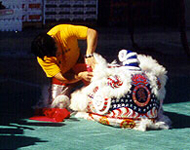
Lion
Dancer Bee Dao prepares a lion head before
a performance for the Chinese new year celebrations.
Mr. Dao teaches and trains lion dance at J.K.
Wong Kungfu Tai Chi Academy in Richardson
under Master Jimmy Wong. |
"It's
such a beautiful art and I have learned to respect
it as an important part of the Asian art, culture,
and tradition," he says. "It seemed silly
when I was first introduced to it, but now promoting
and educating the community about lion dance is
the primary reason why I train."
According
to Chinese lore, hundreds of years ago, a Chinese
village was under constant threat by local bandits,
who dressed up as demons to scare away villagers.
The marauders then took the townspeople's food and
valuables. To defend themselves, the villagers concocted
their own creatures - dragons and lions - out of
papier-mache. The villagers banged their pots and
pans as their colorful creations swayed, scaring
away looters and evil spirits. Thus the lion dance
was born.
Subsequent
generations adopted the lion dance as a traditional
part of the Chinese New Year celebration, as well
as festivals and other special occasions. The lion
dance is believed to bring peace and good fortune.
The
lion dance continues to be a major element of Chinese
culture. And as home to the most established Chinese
lion dance school in the region, the Richardson
area is the lion-dance-instruction headquarters
of the metroplex.
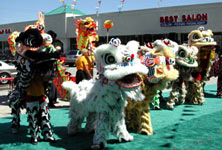
Lions
gather and dance to bring good fortune and
prosperity to people and businesses. The different
colors represent different characteristics
the lions possess. |
The
J.K. Wong Kungfu Tai Chi Academy in Richardson specializes
in teaching the colorful and light-hearted Southern
Chinese Lion Dance. In the Southern Lion Dance,
two dancers are clothed in bright costumes attached
to a heavy papier-mache lion's head. With perfectly
syncopated steps, the dancers mimic qualities attributed
to the lion, including power, fear, and joy.
They
also tell a story that starts with lions awakening
in their cave searching for food. Along the way,
the lions encounter obstacles, as well as happiness,
and must make decisions that put them in peril,
but ultimately land them treasures in such forms
as lettuce (symbolizing fortune and prosperity)
and oranges (symbolizing gold).
"Being
a lion requires agility, strength, stamina,"
says Master Jimmy Wong, owner and master instructor
at the J.K. Wong Kungfu Tai Chi Academy in Richardson.
Mr. Wong expects his students to demonstrate these
qualities. They must practice the dance at least
once a week, in addition to their martial arts training
and most importantly, keep their grades up.
They
must also avoid drinking or smoking. But students
don't seem to mind his requirements and look forward
to the lion dance classes. The students, who range
in age from 5 to just shy of 30, become the lion,
once they dress in the lion costumes.
"A
real lion is playful, sometimes you don't usually
think of. (The lion dance) lets the dancers express
themselves through the lion," says Mr. Wong.
He
has seen lions take on a lighter or more serious
attitude, depending on which two dancers are interpreting
it. The drum and the gong players are also integral
to the production. They must keep a perfect rhythm
with the four-legged creature.
"It's
an effort in teamwork," says Mr. Wong. Unlike
soccer or football where one person can become a
star, lion dance performances require the participation
of the entire group to make it work, he says.
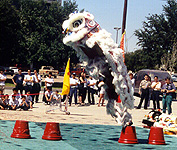
The
Lion leaps across the obstacles displaying
dynamic acrobatic feats in the lion dance
performance. Dancers must be very skilled
and have great trust in each other to achieve
a high degree of performance. |
"And
it is a very acrobatic performance," says Mr.
Wong. Because of its physical demands, the lion
dance is not typically taught as an independent
form. Instead, the lion dance is an art learned
by advanced kungfu students as part of their training,
he says.
"Dancers
must have a strong body, hands and legs for a good
dance," he says. "It's part of the training
requirements."
Today,
academies like the J.K. Wong Academy in Richardson
are not only teaching students the steps to the
lion dance, but also the universal idea that the
dance can bring peace and harmony to those who understand
and embrace it. And they do not have to be Chinese
to appreciate it.
The
Academy performs at community events and special
occasions like weddings and birthdays, as well as
at schools and primarily Chinese-owned businesses
and restaurants.
There
is also a growing interest in lion dancing as a
sport by many American, European, and Asian martial
arts schools. Competitions are being held around
the world for lion dance teams, which Mr. Wong has
brought his team to Malaysia and Hong Kong to compete,
representing the United States.
In
essence, students who learn lion dance also learn
to appreciate Chinese culture and traditions, says
Mr. Wong. "Lion dance is alive and striving
in the west," he says. "It offers a source
to understanding Asian culture and the contributions
of Asian people to the community."
|